
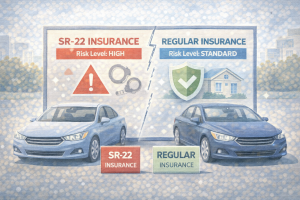
Visual comparison of SR-22 insurance and standard car insurance.
Introduction
Auto insurance is a legal requirement in nearly every U.S. state, but not all insurance policies serve the same purpose. Drivers with serious traffic violations may be required to carry SR-22 Insurance, while most drivers maintain standard auto insurance policies. Understanding the differences between SR-22 insurance vs regular car insurance is essential for drivers navigating high-risk classifications, state compliance rules, and long-term financial planning.
This article provides a detailed comparison of SR-22 Insurance and regular car insurance, explaining how they differ in purpose, cost, coverage, and legal obligations.
What Is Regular Car Insurance?
Regular car insurance is a standard auto policy purchased by most drivers to meet state minimum requirements and protect against financial loss.
Core Features of Regular Car Insurance
-
Liability coverage for bodily injury and property damage
-
Optional coverage such as collision and comprehensive
-
Flexible policy terms and provider options
-
No additional state monitoring beyond normal compliance
For drivers with clean or moderately clean records, regular car insurance is sufficient to maintain legal driving privileges.
What Is SR-22 Insurance?
SR-22 Insurance is not a separate insurance policy, but a certificate of financial responsibility filed with the state by an insurance company on behalf of a driver.
Key Characteristics of SR-22 Insurance
-
Required for high-risk drivers
-
Confirms minimum liability coverage
-
Includes mandatory state monitoring
-
Imposes strict penalties for policy lapses
SR-22 Insurance is typically required after serious violations such as DUI, reckless driving, or driving without insurance.
Purpose: SR-22 Insurance vs Regular Car Insurance
Regular Car Insurance
-
Protects drivers financially in accidents
-
Meets standard state insurance requirements
-
No enhanced oversight from the state
SR-22 Insurance
-
Demonstrates legal compliance for high-risk drivers
-
Ensures continuous insurance coverage
-
Allows states to track policy status in real time
The primary difference lies in regulatory oversight, not coverage type.
Coverage Differences Explained
One of the most common misconceptions is that SR-22 Insurance provides different or additional coverage.
Coverage Comparison
| Aspect | Regular Car Insurance | SR-22 Insurance |
|---|---|---|
| Liability Coverage | Required | Required |
| Collision Coverage | Optional | Optional |
| Comprehensive Coverage | Optional | Optional |
| State Monitoring | No | Yes |
| Filing Certificate | No | Yes |
Both types of insurance rely on the same underlying coverage structure. SR-22 simply adds a compliance layer.
Cost Comparison: SR-22 vs Regular Insurance
Cost is where many drivers notice the most significant difference.
Regular Car Insurance Costs
-
Based on age, location, driving history
-
Average monthly cost: $80–$150
-
Lower administrative fees
SR-22 Insurance Costs
-
Increased premiums due to high-risk status
-
One-time or recurring filing fee ($25–$50)
-
Average monthly cost: $120–$300+
The higher cost of SR-22 Insurance is driven by driver risk, not the certificate itself.
Legal Requirements and Compliance
Regular Car Insurance
-
Must meet state minimum liability limits
-
Coverage lapses may result in fines or penalties
-
No mandatory insurer reporting to the state
SR-22 Insurance
-
Continuous coverage is mandatory
-
Insurers must report cancellations immediately
-
Lapses trigger license suspension
-
Filing period usually lasts 2–3 years
Drivers with SR-22 Insurance face stricter compliance standards.
Who Needs SR-22 Instead of Regular Insurance?
Drivers typically require SR-22 Insurance if they have:
-
DUI or DWI convictions
-
Multiple traffic violations
-
At-fault accidents without insurance
-
License suspension or revocation
-
Court-ordered proof of financial responsibility
Once the SR-22 requirement ends, drivers may return to regular car insurance.
Transitioning from SR-22 to Regular Car Insurance
SR-22 Insurance is usually temporary.
How to Transition Successfully
-
Complete the state-mandated SR-22 period
-
Confirm compliance with the DMV
-
Request SR-22 removal from your insurer
-
Shop for standard insurance quotes
-
Maintain a clean driving record
Many drivers see substantial premium reductions after returning to regular car insurance.
Common Myths About SR-22 vs Regular Insurance
-
SR-22 is a different type of coverage
False. It is only a filing requirement. -
You must keep SR-22 forever
False. Most states require it for a limited period. -
SR-22 always means the highest possible premiums
Not necessarily—rates improve over time with clean driving.
SEO & Consumer Insight: Why This Comparison Matters
From an SEO perspective, users searching “SR-22 insurance vs regular car insurance” are typically:
-
Confused about legal requirements
-
Concerned about costs
-
Considering switching providers
-
Near a purchase or compliance decision
Providing a clear, authoritative comparison builds trust and increases conversion potential.
Conclusion
Understanding the differences between SR-22 insurance vs regular car insurance empowers drivers to make informed decisions about compliance, cost management, and long-term coverage planning. While both serve the purpose of financial protection, SR-22 Insurance includes additional legal oversight and higher costs due to increased risk.
By fulfilling SR-22 requirements responsibly and maintaining safe driving habits, drivers can successfully transition back to regular car insurance and restore financial stability.
Key Takeaways
SR-22 is a filing requirement, not a separate policy
Coverage types are largely the same
Costs are higher due to risk and compliance monitoring
SR-22 is usually temporary